Friday, June 8, 2012


Today, I am going to write about Japanese Anime. My favourite anime series are Zero No Tsukaima and Bleach. The slight element of romance made the Anime seem more colourful or else the Anime would just be hack and slash. The Bleach anime series started in 2004 and ended recently in march 2012. It has been very popular despite the fact that the animation used is not very advanced. In fact the animation is quite limited. In many scenes, only one feature such as the eyes or mouth of the character will move while the rest of the scene will be stagnant. This use of limited animation is a process of making animated cartoons that does not redraw entire frames but reuse, common parts between frames. The Bosko cartoons in the 1930s made use of this technique in order to save time and money. Keep your eyes on the video below. Watch out for the looping background when Bosko starts moving on his cart. From 1.45mins onwards,  even though Bosko is moving forward, the background is reused over and over again.


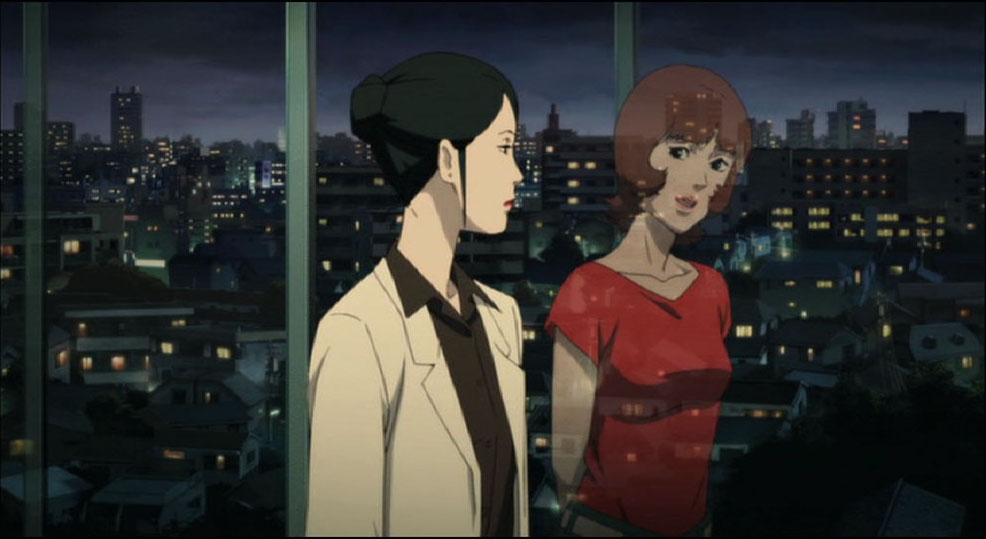
Osama Tezuka also used this technique for Astro Boy. However, I think that the fans of the anime series don't mind because I think it adds to the style of the Anime which makes it comical at times. There are some hallmarks of Japanese Animation that Bleach utilises such as the use of question marks when the characters are confused, or fixed funny faces which each character has a repertoire of. In this way it is very different from animation such as Spirited Away or Paprika which have characters which behave in a more realistic manner. The animation for Bleach is less detailed than the Hayao Miyazaki or Satoshi Kon productions.  This is probably because the television series has less budget and the  standard of animation in-terms of  detail is lower, so  to keep the look consistent and the budget low the movie also has a lot of sequences where the main characters are moving but the extras are stagnant looking like they are still in a comic book.

The picture below shows the crowd as faceless people. They are drawn very simply and when Senna is moving while walking on the tight rope, they are motionless. Note also how the background is blurry and all the focus is on Senna who is a new character introduced in the movie.


In the close up below, you can see how simply drawn she is but yet we can associate with her because her emotions are written on her face. Her amber coloured eyes also make her stand out from the other characters and made her appear more mysterious. This is appropriate because in the plot she is a Shinenju which is composed of the memeories of dead souls and  is the weapon that the antagonists want to use to destroy the world. ( Which by them way is a lame plot. Why do villains keep wanting the destroy the world?)
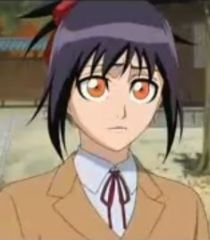
 Bleach is successful because by focusing on the facial expressions and the special moves of the main characters, the audience feels more attracted to the character. The picture below is a scene from the ending just before Senna is about to disappear. And the main character Ichigo is carrying her and he lied to her that the name on the grave is hers whereas it actually belongs to someone whose memories Senna has retained. Even though the background elements are not well defined, the dull colours help to evoke the sadness of the scene. The characters are also placed at the center of the frame so that the focus is on them. The


I also like Bleach because of the effects of the attacks each character does.

This Video below shows the bankai of each different character. Each character has their own unique bankai which is very popular with the audience because it adds to their distinctive personalities. Each of them has a sword which can change once their users unleash their 2nd stance of their sword. Only the higher ranking officials in the Bleach can unleash their bankai. It is usually animated in a very exaggerated manner with lots of glowing lights and makes the character appear very powerful.


Japanese Anime is popular all over the world due to the characters being able to connect emotionally with the audience.  The characters have inspired countless cosplayers who want to someone else. This shows that animation does not need to be realistic or very detailed to capture the imagination, plot and characterisation are what draws and enthralls the audience.


A Cosplayer dressing up as Grimmjow.


Friday, June 1, 2012


Today I will be talking about RATATOUILLE, an animation feature from Pixar. The main character is a young rat called Remy whose dream was to becoming a famous French chief. I think the characterisation of Remy was very important to the film as they had to make a rat endearing and intelligent looking so that the the audience would believe that he could cook. The made Remy look scruffy to make it believable that he is a street rat who was not rich.  Remy also had humanised actions such as standing on two feet and using his hand to hold a pan and he is also shown to be reading.

In the image below, Gusteau is drawn as a flat character so that he will look like an image in a book and this contrast with the back view of Remy which appears more life like. The food on the right page is also drawn in a flattened manner so they would look like images in a Recipe book.


In this scene below, Remy and his father, Django, are having an argument. This looks very much like the human behaviour of a child and his father quarreling. Django is showing authority by pointing a forefinger and staring down at his son. Remy is showing a defiant attitude by sticking his head out and clenching his fist into a ball.


The screenshot below, shows some of  the characters in the restaurant with prominent and big exaggerated noses. The seven characters have distinguishing features which differentiate them from each other. The first from the left has buck teeth, the second guy has a manicured mustache, the third person has a double chin while Colette has light make up such as lipstick on. The guy to Collette's right has a square jaw while the guy behind him has a protruding jaw and the man of African descent has the most elongated face and  his uniform is stained.


 The screenshot below is of the key scene where, Anton Ego, a food critic is just about to taste the key dish of this film - ratatouille.


I read from  http://www.comingsoon.net/news/movienews.php?id=19939 that the top American chief  Thomas Keller was hired to design this dish. As food is so important to this movie the animators had to go through cooking classes so as to learn more about how food textures and restaurant kitchens work. To give the food more realism, the animators used a sub-surface light scattering technique on fruits and vegetables. Adria Ferran was also hired as a food consultant and he lent his voice to the Spanish version of the film.


Other than realistic portrayal of the food, the deliciousness of the food is also conveyed through the character's facial expressions.  

Screenshot before Anton Ego comes for the food tasting. Notice how his lips are in an unattractive dull colour and his complexion is almost white as though he is a corpse.He is also shown sneering.


First Bite

Reaction

In the first picture, Anton's complexion had less colour as he has been show through the film which makes him appear cold and unapproachable.
In the second picture, his face has a pink glow and it seems that the lamp on the table is illuminating him more. His lips are also healthy red. He appears more likable. This helps the plot because the film ends with him helping Colette, Remy and Linguini start a restaurant.


All in all, Ratatouille is a very family orientated film that is heart-warming and enjoyable. Pixar infused the movie with warm glows to convey a cosy atmosphere making audience want to believe in and live in the world.


Thursday, May 24, 2012


This Week, I will be talking about Spirited Away directed by, Hayao Miyazaki, another of my favourites. It is a story about a little girl, Chihiro Ogino, a 10 Year old Girl, who was bored about her own life and did not really cherish her parents and was always reluctant to explore places with them until they were turned into pigs by a witch. The movie consists of many vibrant coloured scenes and interesting looking spirits with human like personalities.  


Spirited Away was the highest grossing film in the history of Japanese cinema. The most astounding thing about this movie is that Miyazaki wrote, directed, storyboarded and even wrote song lyrics for this film. 

In the special features of the Spirited Away DVD, "The Art of Spirited Away<" a commentor said of Miyazaki, "He writes in pictures." 

Storyboard:


The completed scene from the movie:


Most of the film was drawn by hand. Even though computer graphics was used, it did not overwhelmed the film. The film as a whole seems very 2D. But that gives it its own special charm and innocence. 


The character Chihiro, was inspired by a real life 10 year old girl who was the daughter of Miyazaki's friend. Miyazaki thought that the girl was a  " lazy bum" ( he said so in the special features) but he felt that children had strong inner resources. 


In the booklet of the DVD Miyazaki said that, " I tried as much as possible to make the main character an everyday person. So her face is not particularly beautiful. She was not cute or appealing, and I was wondering what do to with her. But by the end of the film, i wasn't worried about her at all and felt quite sure that she would become an attractive person."

i am glad that he did not make her look like Sailormoon because she would not have been as sympathetic.  Her simple dressing and more ordinary features make her more likable so that the audience will care about her journey and adventure. She becomes like the little sister that we want to look after.

The plot with all the gods taking a break at the bath house allows Miyazaki to create many unique creatures that adds to the flavour.


When the rights were bought by Disney  the dubbing process was done meticulously. First, they had to translate the movie not only literally but also had to make sure that American audiences could understand the cultural references. When dubbing, the voice actors had to watch the  movie and match the mouth movements of the characters. 


In total I think that Spirited Away's art is less graphic in the sense that it is suitable for all ages. While Paprika provokes a lot of thinking, Spirited Away finds its way to peoples' hearts. By telling the story from a perspective of a child, the audience is able to think about their own childhood and growth. The lines for Spirited Away are very simple and the scenes not as detailed as Paprika which can be an assualt on the senses. This works well for the film because the simplicity emphasises the innocence of the world. Even the villains Yubaba and Noface are not truly scary and they seem like what a child would imagine.


Wednesday, May 16, 2012


Today, I am going to write about my favourite animation of all time, Paprika (2006) by Satoshi Kon. Its target audience is young adults. It is a complex story with many layers like Inception (2010). The plot in paprika is very complex like Inception because it is like a dream in a dream so the characters cannot tell which is the real world and which is not. Both also have another similarity which is that the dream world and the real world inter-connect and the directors make us think about what reality really is and if the lines between real life and dream life can be blurred. In my opinion,  animation is the best medium to explore the layers of reality because through art work and special effects,  the director can portray rapid changes in scenes and really bring up the element of fantasy. Watching Paprika is like being in somebody elses very own unique/nightmare.

In terms of style, Kon uses hand drawing for the animation characters. The characters are  flattened, and angular. This gives a traditional comic book effect and it is very different from fully CGI dependent animation such as Kungfu Panda.  However, Kon also uses CG effects mainly for the background. It is not always clear which parts are hand drawn and which parts are computer generated. In the Paprika Parade Video below it is clear that the confetti is computer animated while the lead characters such as Paprika and Detective Kogawa Toshimi. The effect of mixing CGI and Hand drawn characters make the film more sophisticated. 


From the "Special Features" of the DVD, "The Art of Fantasy", I learnt that the backgrounds were meticulously done by modeling programs such as Maya.  To distinguish between the dream world and the real world,  the artist used muted and more dull colours for the real world and vibrant and bright colours  for the dreamworld. 

Real World

Dream World: 


In "The Dream CG World" Special Feature, the Director of photography spoke about using CG to enhance the scenes. For example, for the dream parade, they used 650 000 pieces of confetti which were positioned to give the scene a sense of depth and separation between the background and foreground. Even for a scene where a car drives through a tunnel in the rain,  they added a brief reflection of the car so that it will be more realistic. In another scene, the patterns that form on a car window were also carefully studied and recreated.


 In the picture above, Detective Konokawa is running through a warped hall way in his dream. This
scene repeats a few times in the film. In order to create it, the CG team had to think about what it would feel like to walk on something very soft like candyfloss. They took 3 months to perfect this scene alone because they wanted to mimic the feeling of being in a nightmare. 

Satoshi Kon died on Augest 24, 2010 and he could not finish his last film called, "The Dream Machine". When i read his last words I was very moved because  though he was dieing he was still thinking about animation. His biggest regret was not being able to finish his final film since they have already created the storyboards. He said, " I haven't been idly waiting for death, even now I', thiking with my weak brain of ways to let the work  live even after i am gone. But they are all shallow ideas.". This touches me because it shows how much passion he has for animation. Here is a link to the rest of his translated letter: http://makikoitoh.com/journal/satoshi-kons-last-words


Wednesday, May 9, 2012


In class this week, we focused on Warner Brothers. My favorite character  was Daffy Duck because he had a very strong personality. In "Duck Amuck" ( 1953) Daffy Duck was drawn and redrawn in front of the viewers' eyes, but his voice as well as his distinctive beak was still recognisable. I also found it more interactive because he had eye contact with the viewer in the sense that he appeared to be talking directly to the viewers. In the theatre this is known as breaking the fourth wall and this breaks the illusion that we are watching a cartoon. This makes it very different from the earlier animation we watched. Watching the artist drawing Daffy Duck with different costumes makes us think about how costumes affect the characterisation of a cartoon personality. For example, Donald Duck's trademark costume is a sailor's costume and Mickey Mouse has iconic red pants.

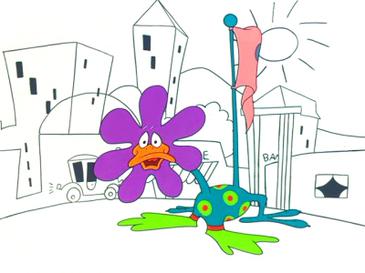
However, even when Chunk Jones turns a Daffy Duck into a flower, the character was still identifiable because the voice and personality remained the same. In this cartoon, Daffy Duck comes across as dissatisfied and angry.  Right before he is erased he says "Buster, it may come as a complete surprise to you to find that this is an animated cartoon, and that in animated cartoons they have scenery, and in all the years I've..."  Chuck Jones is playfully making the viewers think about our expectations about cartoon conventions.   By making Daffy Duck question the artist's intentions,  he is giving Daffy Duck a life beyond existing in the cartoon. Daffy is like an actor, who is trying to play his role right, but the stage designer, the costume designer and the director are all making fun of him.

It is interesting when he is erased, he never dies and he asks, " All right wise guy, where am I?" I am sure that i am not the first person to notice that this cartoon ask profound questions about our relationship to a creator and also the relationship between art and identity.  I recently watched a play called "Freud's Last Session" at the Esplanade where Sigmund Freud and C.S Lewis discuss the existence of god. In The Truman Show (1998), Jim Carrey's character is like Daffy Duck because he questions his surroundings and  the sets he is living in.  Like The Truman Show, the creator is revealed at the end of Duck Amuck and it is...Bugs Bunny. In 1955, Chuck Jones put Bugs Bunny and Elmer J.Fudd in a reverse situation in " Rabbit Rampage"


Thursday, April 26, 2012

In class this week,  I learnt about the Silent Era which was from 1914 - 1928. Although I found out Felix the Cat was the first animation cartoon superstar, I was still mesmerised and curious why Mickey Mouse has such lasting popularity till now. I am glad that Disney listened to his wife and not name Mickey Mortimer Mouse because the name did not sound children friendly. I was also very surprised to learn that Mickey Mouse was modeled after Charlie Chaplin.
After doing some research I found this quote:
"We felt that the public, and especially the children, like animals that are cute and little. I think we rather indebted to Charlie Chaplin for that idea. We wanted something appealing, and we thought of a tiny bit of a mouse that would have something of the wistfulness of Chaplin-a little fellow trying to do the best he could."
I watched The Gold Rush (1925) where Chaplin acted as a tramp  who wanted to take part in the Klondike Gold Rush and I felt very sad for him because he fell in love with a girl and he thought she was also in love with him but she was not in love with him.


My favorite scene from The Gold Rush is the one where he dances with the bread. I have actually tried this before but realised that it is a lot more difficult then it seems.  How does this relate to Mickey Mouse? I think that one reason that Mickey Mouse was so popular was because  like Charlie Chaplin, he is the underdog (undermouse) with a heart of gold, lots of little talents, a fun loving spirit and cheers people up.


I think that the fact that the early Mickey Mouse shows and Charlie Chaplin was so famous because they were both silent. The story had to be told by actions and the use of music this made them more universal and most of the time the plots are very simple. I think that even though animation is very advanced now a days and we can do special effects that are a lot more impressive. I think at heart, characterisation is most important for a good animation. The simplicity of Mickey Mouse in the Silent Era has a charming effect. Even though Walt Disney also said, " All cartoon characters and fables must be exaggeration , caricatures. It is the very nature of  fantasy and fable," I think that animation characters nowadays are even more exaggerated. I think the more complex the animated character, the more limited the appeal. This quote reminds me of my all time favorite animation film maker, Satoshi Kon.In my next post, I am going to focus on Warner Brothers. Here is a picture of Charlie Chaplin and Mickey Mouse!